
How to Get Google Reviews for Your Hair Salon After Every Appointment
Hair salons have a natural review moment right after the reveal. Here is how to turn that moment into a consistent Google review workflow.

To get a Google review after every salon appointment, make the ask a fixed step in the chair-turn moment when the client is looking at the result, not something a stylist tries to remember. Wire it into the closing routine and send a short follow up for any chair that missed the moment. Two stylists work in the same salon, do equally good work, see roughly the same number of clients per week. One of them brings in twenty Google reviews a month for the salon. The other brings in two. The talent gap between them is zero. The training gap is zero. The clientele is comparable. The only meaningful difference is that one of them has wired the review ask into the chair flow as a habit, and the other one is still trying to remember to ask. That single operational difference is what separates salons that quietly accumulate hundreds of fresh reviews a year from salons that have been stuck on the same forty-something review profile for the last two summers.
This post is the operational companion to the salon review pillar. The pillar covers the strategic moves: the mirror reveal as the right moment, the stylist-versus-salon-name problem, the delayed window for colour clients. This article is about turning those strategy points into something that actually happens in the chair, every appointment, on every shift, including Saturday afternoons when the room is full and one stylist is running thirty minutes behind. BrightLocal's Local Consumer Review Survey consistently finds that the closer the prompt is to the moment of value, the higher the conversion, but the prompt has to actually happen. The single biggest reason most salons underperform on reviews is not strategy. It is operational consistency.
Why ask after every appointment rather than just happy clients?
Most salons treat reviews as a campaign. They run a push for a couple of weeks, get a small spike, and then the energy dies. The new station cards stop being mentioned. The team forgets the script. The owner gets pulled into something else. Three months later the most recent review on the profile is from forever ago, and walk-ins are quietly asking themselves why this place looks abandoned online when the room itself looks busy. The cure is not another campaign. It is treating the review ask as part of finishing the appointment, the same way you would treat checking the cape, sweeping the station, or talking through aftercare. The ask becomes a step in the procedure, not a thing the team has to remember.
Once the framing shifts from "please remember to ask" to "this is part of how we end an appointment," the reviews start to compound on their own. Most salons that consistently pull thirty or forty new reviews a month did not work harder than their neighbours. They just made the ask part of the chair flow and stopped trying to remember it.
The chair-turn moment in detail
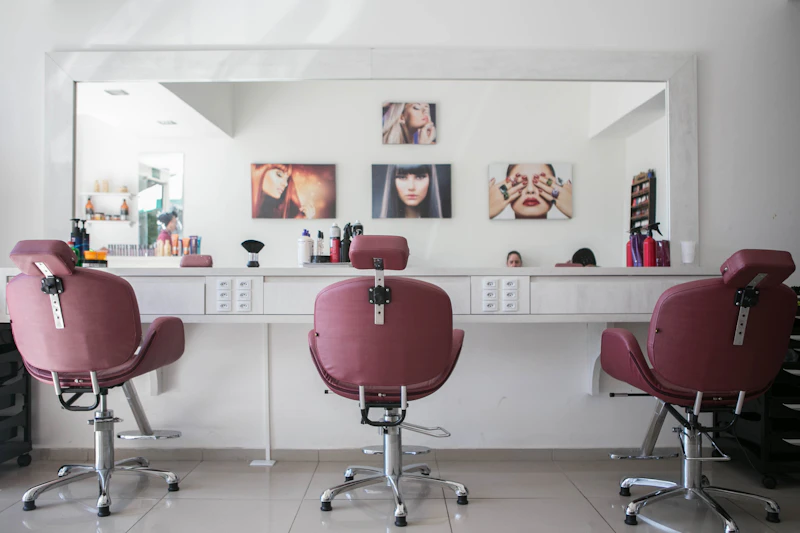
The window where a client is most likely to actually post a Google review is roughly the ninety seconds between the chair turn and the client standing up. The reveal moment is the emotional peak of the visit. The result is staring back at them in the mirror, the cape comes off, the phone is already in their hand for a selfie, and the dopamine has not yet been replaced by traffic, dinner plans, or the next thing on their day. Asking inside that window converts sharply higher than any later prompt. The trick is to not let the moment pass without saying something, and to keep what you say short and tied to what the client just said about the result.
What the stylist actually says matters less than how it lands. The polished, scripted version ("if you enjoyed your service today, we would really appreciate a Google review") sounds like every other ask the client has ignored this month, and converts at maybe one in ten. The natural version sits inside a real conversation. The client says "I love it." The stylist says "that makes my day, honestly. If you have ten seconds, a quick Google review for the salon really helps us." That version converts closer to one in three. The asymmetry is huge and it comes from a single difference: one of them ties to a real moment the client just lived, and the other one feels like a transaction tacked onto the end of the appointment.
- "I am so glad you love it. If you have a second, a quick Google review for the salon really makes our week."
- "That makes me so happy. While I get the cape, if you can drop us a Google review, that genuinely helps the team."
- "Thank you so much, that means a lot. A quick review on Google would honestly mean a lot to all of us here."
- "Glad it turned out the way you wanted. While you are at the mirror, the QR card right there is one tap to a Google review if you have a moment."
Building it into the team's chair flow
The training that actually changes behaviour is not a memo or a script handout. It is fifteen minutes on a Tuesday morning, with the team in the chairs, role-playing the chair turn moment a few times. Each stylist tries the line in their own voice. The owner or manager listens for two things: did the line tie to something the client just said, and did it feel like the rest of how the stylist talks. If yes to both, that is the line for that stylist. They do not need to use the same words as anyone else. They need to use words that sound like them. Scripts that get memorised land flat. Scripts that get adapted to each stylist's natural voice land warm.
The other piece is making the QR card visible at the chair before the stylist even has to gesture at it. A small acrylic stand on the station counter, in eye line during the chair turn, removes one step from the ask. The stylist no longer has to explain where to scan. They can say "the card right there" and the client is already looking at it. That single physical detail moves the conversion meaningfully because it shrinks the perceived effort.
Try Kaisah
Turn happy customers into posted Google reviews.
What do you do when the chair is running behind?
Saturday afternoons in a busy salon are the worst-case for review collection. The stylist is thirty minutes behind, the next client is already in the waiting area, the chair turn happens fast, and the conversation jumps straight from "do you love it" to "let me grab the cape." The instinct in that moment is to skip the ask, because the energy in the room is rushed. That is the moment to lean on the QR card and a four-word version of the line: "the card if you can." Pointed at, not explained. The client gets the prompt without the stylist having to slow the room down.
The other backup for busy days is the front desk. The stylist gives a short heads-up at the chair turn ("the team would love a Google review if you are open to it, the desk has the QR") and the receptionist follows up at checkout with a calm "if you have a moment to drop a quick Google review for the salon, the QR is right here." Where that QR sits matters, and our guide to the best QR code placements for salons covers the full ranking. The front-desk version converts lower than the chair version, but on a Saturday it is the version that actually happens, which means it produces real reviews instead of intentions.
The follow-up message for chairs that missed the moment
A meaningful chunk of clients will leave the salon without scanning, even when everything went well. The right backup for them is a single follow-up message. For cut clients, send it the same evening, while the visit is still recent and the result has not started to grow out. For colour clients, wait two to four days, after the colour has settled and the client has lived with it under daylight. The colour-specific delay matters: clients evaluate colour over time, and a same-day text often catches them before they have actually fallen in love with the result.
- Cut clients: send the message the evening of the appointment, when the cut still feels new
- Colour clients: wait two to four days, after the colour has settled and the client has shown friends
- Lash and brow clients: 24 to 48 hours, when the result has settled but the client has not yet handled it daily
- Always tie the message to the specific service ("hope the balayage settled in nicely") rather than a generic visit reference
- One message only. Do not chase clients who do not respond; the silence is itself an answer
Tracking whether the ask is actually happening
The salons that fix this problem permanently have one practical mechanism in common: they track the ask, not just the result. The owner or manager looks at the count of reviews per stylist per week, alongside the count of appointments per stylist per week, and the ratio tells the story. A stylist with thirty appointments and one review per week is not asking. A stylist with thirty appointments and eight reviews per week is asking and asking well. Once the team knows the ratio is being looked at, the ask happens reliably. Once the ask happens reliably, reviews compound.
The mechanism does not need to be a dashboard. A whiteboard in the back room with each stylist's review count for the week, updated every Friday, does the same job. Behaviour follows attention, and attention follows visibility. Salons that simply make the count visible see better consistency than salons that talk about reviews in vague terms during meetings.
Why some stylists quietly stop asking
Even after the ask is wired in, a few stylists drift away from doing it consistently. The reasons are predictable, and most of them are fixable in a five-minute conversation. The most common is awkwardness fatigue: the stylist felt weird about the ask the third or fourth time, and they quietly stopped. The fix is to remind them that the ask is part of the procedure, not a personal favour, and that the awkwardness goes away once the wording becomes reflex. The second reason is a recent decline: the stylist had a client say no and took it personally. The fix is to normalise the no in advance and make clear that the next happy client is fifteen minutes away.
The third reason is that a stylist tried offering an incentive ("a free deep conditioner next time if you leave us a review") and got pushback. Google's review content policy explicitly prohibits incentivising reviews, and reviews collected this way can be filtered or removed with potential profile penalties. The fix is to make the no-incentive rule clear up front, and to point out that a frictionless review flow plus a sincere ask consistently outperforms any incentive structure.
The bottom line
Getting Google reviews after every salon appointment is not a willpower problem or a marketing problem. It is an operations problem. Once the ask is part of the chair flow rather than a thing to remember, the review count grows on its own. Train the team in their own voice, put the QR card in the eye line of the chair turn, lean on the front desk and a follow-up message for the chairs that missed the moment, and track who is asking. The Kaisah salon workflow handles per-stylist tracking and the editable draft, with plans on the pricing page. Most of the work is in the first two weeks. Most of the payoff is in the next two years.
Related reading
A few hand-picked pages to go deeper on this topic.
Read next
More Kaisah articles on industry playbooks and nearby review-conversion topics.

How to Get More Google Reviews for Your Hair Salon
Salons do not have a quality problem, they have a follow through problem. Here is what actually works in the chair, at checkout, and three days later when the colour finally settles.
Best QR Code Placements for Salons to Get More Google Reviews
Salon QR codes work best when they appear at the happy post-appointment moment. Here are the placements that make clients more likely to scan and review.
Salon Google Review Request Text Message Examples
The best salon review texts sound personal, specific, and easy to act on. Use these examples after appointments without sounding pushy.
FAQ
Quick answers for the most common questions around this topic.
What is the single best moment in a salon visit to ask for a review?
Right after the chair turn, when the client first sees the finished look in the mirror. They are at peak satisfaction, the result is staring back at them, and they often have their phone out for a selfie. Asking at that moment converts at a far higher rate than asking at the front desk after the spell has worn off, and far higher than any follow up message sent later that day. The window is roughly the ninety seconds between the chair turn and the client standing up, and a salon that wires the ask into that window will outperform any other approach.
Should the stylist or the front desk make the ask?
The stylist, ideally, because the relationship is most personal at the chair and the timing aligns with the reveal moment. The front desk should be a backup for clients who slipped past the chair ask. Stylists who treat the review prompt as part of finishing the appointment, in the same way they would discuss aftercare, almost always outperform salons that delegate the ask to a separate transactional step at checkout. On busy days, a quick chair-turn heads-up plus a calm front-desk follow-through is the realistic combination that actually happens.
Where should the QR code go in the salon?
On the mirror or station card is the highest converter, because it lines up with the reveal moment when the client is most likely to scan. The checkout counter is a strong secondary placement for clients who left the chair without scanning. Aftercare cards extend the window into the days after for colour, lash, and brow clients. Avoid the waiting area as the primary spot, since clients there have not yet had the experience you want them to review, and using it as the primary spot can prompt reviews based on first impressions rather than the actual service.
Is it okay to give a discount on the next visit in exchange for a review?
No. Google's review content policy explicitly prohibits offering anything of value in exchange for a review, and reviews collected this way can be removed and the salon profile penalised. The right play is to remove friction from the review process rather than to add incentives. A great cut, asked for at the right moment, with a one-tap path to Google, will produce more sustainable reviews than any loyalty offer, and it does so without putting the entire profile at risk if Google decides to clean up incentivised reviews on the listing later.
How do I handle clients who say they will review later but never do?
Send a single short message later that day for cut clients, or two to four days later for colour clients, with a one-tap link to the review form. Keep the tone personal and tied to the specific service, not transactional. Do not send a second message if the first is ignored. The client who said they would review and did not has effectively declined, and chasing them tends to convert silence into mild annoyance rather than reviews. A single, well-timed follow-up captures the meaningful ones and respects the rest.
How do I get the team to ask for reviews consistently without it feeling forced?
Train each stylist to use the line in their own voice rather than a memorised script. A line that sounds like the stylist talks lands warm; a line that sounds memorised lands flat, no matter how good the wording is on paper. The other half is visibility: track review counts per stylist per week and make the numbers visible to the team. Behaviour follows attention. Salons that quietly track who is asking and who is not see consistency improve within two weeks without anyone needing to be lectured.