
Best QR Code Placements for Salons to Get More Google Reviews
Salon QR codes work best when they appear at the happy post-appointment moment. Here are the placements that make clients more likely to scan and review.

A salon owner reads three different review articles in one afternoon, gets fired up, and the next morning their team prints fifteen QR cards and sticks them everywhere. There is one on the mirror, one on the back of the chair, two on the checkout counter, one in the bathroom, three on the aftercare shelf, four on the styling station, and a giant one taped to the front door. A month later, scan rates are down compared to the salon next door which has exactly one well-placed card on each station counter. The intuition that more codes equals more scans is wrong in salons, and the reason it is wrong is that salon clients are looking for one clear cue, not a wall of them. A code that is everywhere ends up reading as decoration. A code in one obvious place reads as an invitation.
The best place to put a review QR code in a salon is the station counter within the client's eye line at the chair turn, with the checkout counter as the strongest secondary spot and aftercare cards extending the window for colour, lash, and brow clients. The waiting area and bathroom convert worst. Pick one or two strong placements, not a dozen scattered ones.
The right placement strategy in a salon comes down to two questions, and the right answer narrows the choices fast. First, where is the client most likely to be at peak satisfaction? Second, where do they have the attention to actually act on a prompt? Lining those two windows up is the entire game. BrightLocal's Local Consumer Review Survey consistently shows that prompts placed at the moment of value convert best, and beauty services have one of the clearest moments of value in any local business. The mistake most salons make is putting cards in places that are convenient for the salon (the front door, the waiting area, the bathroom) rather than in places where the client is in a position to scan.
This article is the practical placement guide for hair salons, barbershops, nail salons, spas, and brow or lash studios. It pairs with the wider salon playbook on getting more Google reviews for your hair salon. Each format has slightly different best placements because the rhythm of the visit is different, but the underlying logic is the same: one or two carefully placed cards beat a dozen scattered ones, every time.
The placement principle: peak satisfaction meets free attention
Two windows in a salon visit produce the bulk of review scans. The first is the chair-turn moment, when the client sees the result and the dopamine of the reveal is fresh. The second is the in-between moments when the client is stationary but unoccupied: nails drying, foils processing, the few minutes between treatment end and exit. Cards placed in either window do real work. Cards placed at the front door or the waiting area underperform reliably, because the client at those points has not yet had the experience you want them to review (or has already left the experience and shifted mentally to whatever is next on their day).
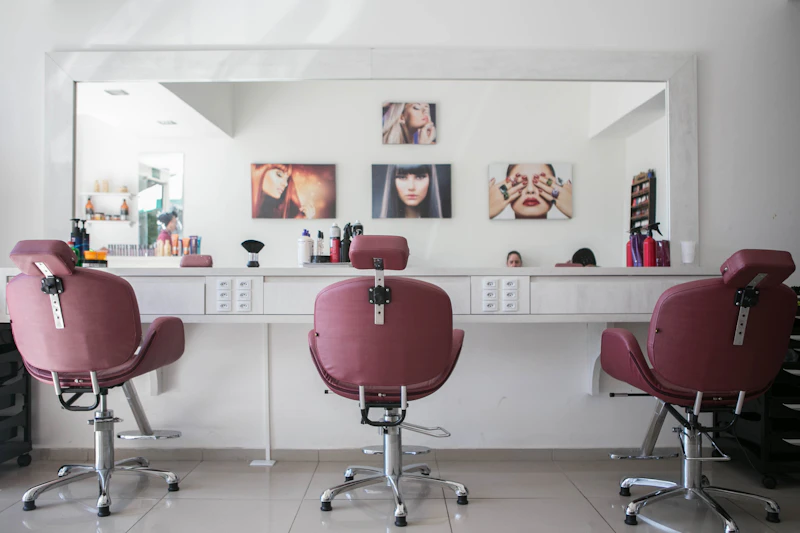
The other principle is that the card has to be in the client's natural eye line, not behind them or above them. A QR card on the wall above the mirror gets seen but not scanned, because the client never looks down at it from a comfortable angle. A small acrylic stand on the counter, in front of them at chair height, gets scanned because the eye line is already there.
The station counter (highest converter, hair salons and barbershops)
For any salon where the client sits at a chair facing a mirror, the station counter is the single best placement. A small acrylic stand, four to six inches tall, sitting on the counter directly in front of the client during the chair turn, lines up exactly with the moment of peak satisfaction. The stylist can naturally gesture at it ("the card right there is one tap to a Google review if you have a moment") without having to break the rhythm of the conversation. The card is not asking the client to do anything they were not already doing. It is offering a path while their phone is already in their hand.
Practical details that quietly matter: the stand should be matte rather than glossy, because salon lighting bounces off glossy surfaces in a way that makes scanning unreliable. The card itself should be at least four by six inches, with the QR code at minimum one and a half inches square (salon lighting is dim and the angle is awkward, so codes need to be larger than they would in a brightly lit cafe). And the wording around the code should reference the actual service: "Loved your colour today? Quick Google review" beats "Scan to leave a review" by a meaningful margin.
The checkout counter (best secondary placement)
Every client passes the checkout counter on the way out. Even if they did not scan in the chair, they have one more chance here while their phone is in their hand and they are settling the bill. The card should be at the height where the client looks down to sign or tap their card, with one short line of copy: "Loved your visit? Quick Google review for the salon." The receptionist can mention it in passing while they process the payment, but the card itself does most of the work even without a verbal cue.
The checkout placement catches a specific kind of client: the one who is happy with the service but does not naturally pull out their phone in the chair, and would have walked out without ever being prompted. That client converts at the counter when they would not have at the chair, which is why this placement is essential as a backup even though it never matches the chair-turn conversion rate.
Aftercare cards (extends the window for colour, lash, brow)
If you give clients an aftercare card after the service (with instructions for caring for colour, lashes, brows, nails, or skin treatments), add a review QR to the same card. The aftercare card extends the review window into the days after the appointment, which is uniquely valuable for services that are evaluated over time rather than at the chair. Colour clients do not always know they love the result on the day; they often only realise it on day two or three when the toner has settled and they have shown friends. The aftercare card sits on their dresser or in their bag and gets read again at exactly the right moment.
The wording on the aftercare-card QR should be different from the in-salon prompt. Instead of "Loved your colour today," use something like "Loving how the colour settled in? Quick Google review really helps the salon." The shift acknowledges the time gap and lands more naturally for a client looking at the card three days after their appointment.
Try Kaisah
Turn happy customers into posted Google reviews.
The nail drying station (specifically for nail salons)
Nail clients have ten to fifteen minutes of stationary attention between the polish finish and the moment they can safely use their phone. That window is uniquely valuable in beauty services because the client cannot do much else (they are protecting wet polish), they have their phone available with a stylus or careful finger, and they are sitting at peak satisfaction looking at fresh nails. A QR card propped at the drying station, designed to be scanned without the client having to use their nails directly, captures a meaningful share of nail-salon reviews. Use a stand rather than a flat card so the angle works for clients who are deliberately not pressing fingers down.
The treatment room exit (for spas and brow/lash studios)
Spas and brow or lash studios have a different rhythm than hair salons. The client comes out of a private treatment room rather than a chair turn, and the moment of revelation often happens in front of a mirror just outside the room. A small QR card on a small console table near that mirror, with copy that ties to the specific service ("Lashes looking good? Quick Google review really helps the studio"), captures the post-reveal moment in a format that suits the room. Avoid placing the card inside the treatment room itself; the room should remain associated with the relaxed treatment experience, not with a transactional ask.
Which salon QR placements should you avoid?
Three placements are tempting but consistently underperform as primary spots in a salon. The first is the waiting area, where clients have not yet had the service and any review they leave is based on first impressions. The second is the front door, where clients are mentally on their way out and the request reads as a transaction tacked onto the exit. The third is the bathroom, which catches a tiny fraction of clients with bad eye lines and weird optics around asking for reviews from inside a bathroom. None of these are wrong as tertiary placements, but treating any of them as primary leaves the high-converting moments at the chair, the checkout, and the aftercare card unused.
- Waiting area: client has not had the service yet, prompts there encourage first-impression reviews
- Front door: client is mentally leaving and the ask reads as transactional
- Bathroom: low conversion, awkward optics, low priority
- Wall posters above the mirror: visible but rarely scanned because the eye line is wrong
- Branded stickers all over the salon: dilutes the prompt, the brain filters repeated visual elements out
Placement combinations by salon type
- Hair salon: station counter (primary) + checkout counter (secondary) + aftercare card for colour clients
- Barbershop: station counter (primary) + payment counter (secondary), aftercare cards rarely needed
- Nail salon: drying station (primary, unique) + checkout (secondary) + aftercare card for gel and acrylic clients
- Spa: treatment room exit mirror (primary) + reception (secondary), avoid in-room placement
- Brow and lash studio: chair-side or treatment exit (primary) + aftercare card (essential, extends the multi-day evaluation window)
Visual side: size, contrast and material
The placement is most of the work, but the physical card has to scan reliably for the placement to matter. The QR code itself should be at least one and a half inches square (larger than a typical restaurant code, because salon lighting is dim and angles are awkward), with high contrast (dark code on light background, never reversed), and clear whitespace around it. Acrylic stands beat folded paper for any placement that gets touched, splashed, or moved around. Matte finishes scan more reliably than glossy ones because they do not reflect the strong overhead lighting common in salons. Google's Business Profile guidance encourages making review collection easy and visible, which is the spirit of getting these visual details right rather than treating them as cosmetic.
Testing what actually works in your room
Once your placements are in, use a different tracked link behind each QR card so you can see which placements actually generate posted reviews. Most modern review tools, including Kaisah, attach a source tag to scans that lets you attribute reviews back to specific cards. After two to four weeks of data, one or two placements will usually pull clearly ahead. The right move at that point is to lean into the winner (better lighting on the card, slightly larger size, more visible angle) rather than spreading effort across a dozen marginal placements. The salons that compound on reviews over time are not the ones with the most cards. They are the ones whose two best placements are dialled in to scan reliably every single appointment.
The bottom line
QR placement in a salon is a small handful of high-leverage spots, not a decoration job. The chair-turn or treatment-exit moment plus the checkout counter cover most of the in-room conversions. The aftercare card extends the window for services with a delayed evaluation. The nail drying station captures a uniquely good window for nail salons. The Kaisah salon workflow ties the placement to source tracking and an editable review flow, with plans on the pricing page. Two to three well-placed cards, sized correctly for salon lighting, beat a dozen poorly placed ones every time. Most of the work is in the first week. Most of the payoff is in the next two years.
Related reading
A few hand-picked pages to go deeper on this topic.
Read next
More Kaisah articles on industry playbooks and nearby review-conversion topics.

How to Get More Google Reviews for Your Hair Salon
Salons do not have a quality problem, they have a follow through problem. Here is what actually works in the chair, at checkout, and three days later when the colour finally settles.

How to Get Google Reviews for Nail Salons and Beauty Studios
Nail salons and beauty studios need reviews that describe detail, cleanliness, comfort, and final results. Here is how to collect them naturally.
Salon Google Review Request Text Message Examples
The best salon review texts sound personal, specific, and easy to act on. Use these examples after appointments without sounding pushy.
FAQ
Quick answers for the most common questions around this topic.
Where should a salon put a Google review QR code?
The single highest-converting placement for hair salons and barbershops is the mirror or station card, because it lines up with the chair-turn moment when the client first sees the result. Checkout counters work well as a backup for clients who left the chair without scanning. Aftercare cards extend the window into the days after the service, especially for colour, lash, and brow work where the client evaluates the result over multiple days. Avoid the waiting area as a primary placement, since clients there have not yet had the experience you want them to review and the few who scan often produce reviews based on first impressions rather than the actual service.
Should each stylist have their own QR code?
If you want to track which team members drive the most review follow-through, separate tracked QR codes per stylist work well, and the review should still point to the salon's main Google Business Profile rather than to individual stylist profiles. This gives the salon visibility into which stylists are most consistent at making the ask, which is useful operational data and supports coaching where it is needed. Avoid creating separate Google profiles per stylist, which fragments your search presence and can lead to listing duplication issues with Google that take weeks to clean up.
Should the QR code be on the mirror itself or a separate stand?
A small acrylic stand on the station counter usually works better than a sticker on the mirror itself. Stickers on the mirror can interfere with the visual reveal moment, which is exactly the moment you want the client focused on the result, not on a code. A stand placed within easy reach but slightly off to the side gives the stylist a natural physical object to point to when making the ask, and it is easier to swap out if the wording or design needs to be updated later without scraping vinyl off glass.
How big should the salon QR code be?
At least one and a half inches by one and a half inches, ideally larger. Tiny QR codes that require precision often get one or two failed scan attempts before the client gives up, especially in dim lighting common in salons and at the awkward angles clients scan from in the chair. The code should also have plenty of white space around it, since QR readers struggle with cards that crowd the code with branding or background art, and the contrast should be dark code on light background rather than reversed colours that most phone cameras handle poorly.
How do I know which placement is actually working in my salon?
Use a different tracked link behind each QR code (mirror, checkout, aftercare card) so you can see which placements actually generate posted reviews. Most modern review tools attribute scans back to the source automatically. After two to four weeks of data you will usually see one channel pulling clearly ahead, and reallocating effort toward that channel is the highest-leverage change you can make to the review program. Salons that track this systematically tend to find the chair-turn placement is doing seventy to eighty percent of the work, with the checkout card mopping up the rest.
How many QR cards should I have in the salon total?
Two to three is the right answer for most salons, not a dozen. A primary placement at the chair or treatment exit, a backup at the checkout counter, and a third on the aftercare card for services with a delayed evaluation window. More cards than that dilute the prompt and start to read as decoration rather than as an invitation. The salons that compound on reviews are not the ones with the most cards. They are the ones whose two or three best placements are dialled in to scan reliably every single appointment.